
2027-2031
OCFSN’s 5 Year Strategic Plan
GOAL 1: GET GOOD THINGS DONE TOGETHER
Establish Strategic Groundwork and Shared Direction
-
1.1.2 Clearly define and document OCFSN’s purpose, scope, unique role, and relationship to member-led work within Oregon’s food system
1.1.2 Use shared language to describe OCFSN’s value, theory of change, and role as convener, capacity-builder, fund mobilizer, and backbone support
1.1.3 Engage members and partners in ongoing discussion, reflection, and learning to build shared understanding without requiring full alignment on every issue
1.1.4 Use mission, vision, values, theory of change, and member priorities to guide decision-making, areas of focus, partnerships, and growth
1.1.5 Regularly revisit OCFSN’s identity and strategic direction as network, funding landscape, and food system conditions change
1.1.6 Establish clear principles and boundaries for when and how OCFSN supports policy alignment, dialogue, and collective influence
-
1.2.1 Design and host regular, well-facilitated convenings, both statewide and regional, in person and virtual
1.2.2 Cultivate cross-regional, cross-sector, and issue-specific relationships through working groups, convenings, and partner coordination
1.2.3 Serve as a trusted backbone organization that supports collaboration, coordinates resources, and does not compete with members
1.2.4 Support members and partners with shared priorities to coordinate policy, systems, narrative, and resource strategies
1.2.5 Coordinate and support collaborative projects developed by members, working groups, and partners
1.2.6 Create and maintain clear protocols for network roles, decision-making, participation, accountability, and working group formation
1.2.7 Amplify shared learning, value-aligned practices, and member-led innovations
GOAL 2: GROW KNOW-HOW & IMPACT
Build Capacity, Learning, and Adaptability

-
2.1.1 Provide targeted capacity-building supports based on member needs, including organizational development, grant readiness, compliance, collaboration, communications, and program implementation
2.1.2 Offer tailored technical assistance, learning collaboratives, and peer learning opportunities
2.1.3 Support members in adapting to changing funding, policy, federal requirements, climate, and community conditions
2.1.4 Regularly refine support offerings based on member feedback and emerging opportunities
-
Description text goes here
GOAL 3: BE JUST
Foster Equitable Participation and Shared Power

-
3.1.1 Identify, address, and reduce barriers to participation, including those related to time, compensation, language, technology, geography, relationships, and institutional power
3.1.2 Prioritize frontline-led, Tribal, culturally specific, rural, and community-based organizations in capacity-building, leadership opportunities, and resource allocation
3.1.3 Embed an equity lens, representation, and shared-power practices in governance, working groups, funding decisions, and network decision-making
3.1.4 Formalize equity practices through policies, accountability mechanisms, transparent criteria, and regular evaluation
GOAL 4: GROW KNOW-HOW & IMPACT
Build Capacity, Learning, and Adaptability

-
4.1.1 Clarify and update OCFSN governance roles, responsibilities, decision-making authority, and relationships among the Board, Leadership Team, staff, members, and working groups
4.1.2 Maintain a clear division of roles between OCFSN and member organizations, especially in funding, advocacy, implementation, and public representation
4.1.3 Regularly assess governance, staff capacity, member experience, and organizational health 4.1.4 Invest in staff wellbeing, capacity, continuity, and right-sized workloads
4.1.5 Strengthen financial sustainability through diversified revenue, multi-year funding, earned revenue where appropriate, operating reserves, and staffing models aligned with organizational capacity, values, and purpose
-
4.2.1 Align communications with OCFSN’s mission, vision, values, theory of change, and role in the network
4.2.2 Use narrative, examples, and member stories to demonstrate network impact while honoring cultural context and consent
4.2.3 Coordinate messaging across channels, including sharing member stories and network priorities with state-level audiences
4.2.4 Develop and implement a strategic communications and brand plan that includes accessibility, plain language, and multilingual communications where feasible
4.2.5 Use communications to grow participation, engagement, relationships, and funding
-
4.3.1 Steward earned, public, and philanthropic funds with transparency and accountability while avoiding competition with member organizations
4.3.2 Align resource allocation with strategic priorities, equity commitments, member priorities, and transparent criteria
4.3.3 Communicate clearly about funding opportunities, funding decisions, pass-through grants, and OCFSN’s role in resource stewardship
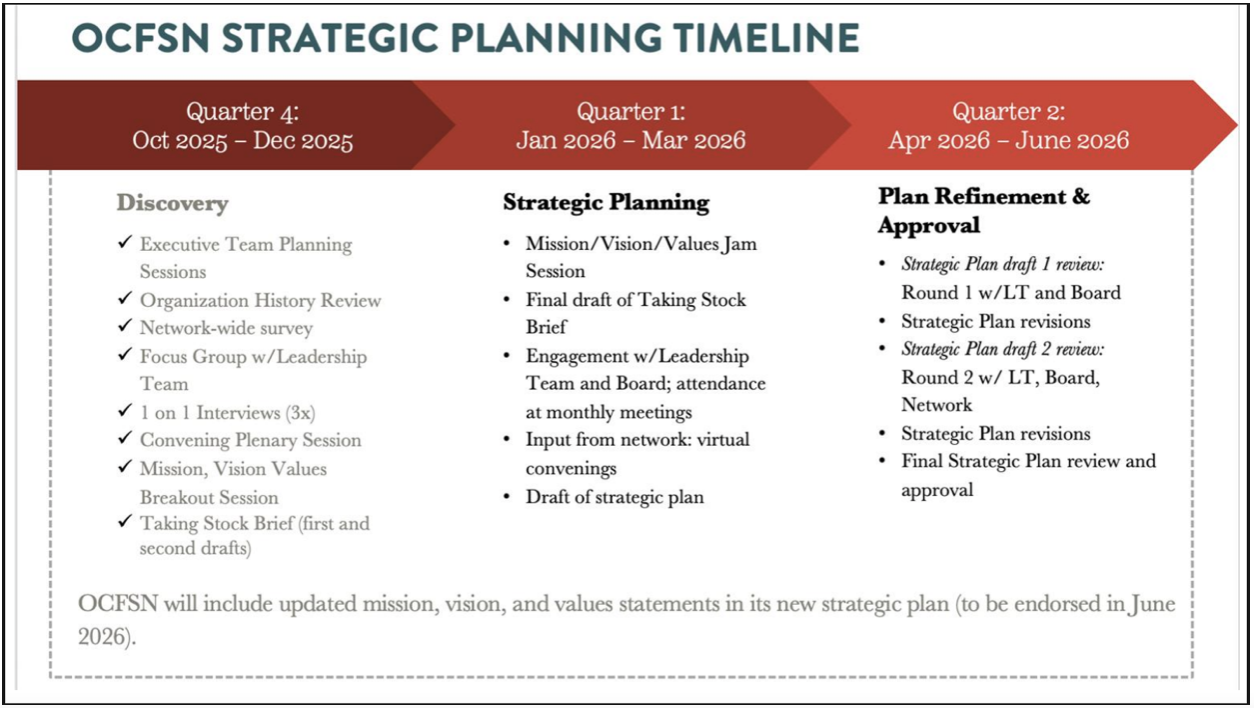
Read more about our strategic planning process and partners through the process.
-
produced a composite picture of current conditions, member and other stakeholder perspectives, strategic questions, and early strategic priorities. This phase included document review, staff and leadership engagement, member interviews and focus groups, member input through multiple online surveys and requests for feedback, facilitated discussions at the November 2025 convening, virtual network-wide input sessions, and the production of a Taking Stock Brief. The Brief provided an in-depth look at opportunities, assets, issues, strategic questions, recommendations, barriers, and needs, informed by the extensive engagement of many members and other stakeholders in the planning process. The Brief went through multiple revisions, each time integrating feedback from OCFSN members, appointed leaders, and staff.
Read the full Taking Stock Brief.
Read the Executive Summary.
-
produced updated mission, vision, and values statements; a theory of change; goals, objectives, and strategies surfaced during the Taking Stock process; and a strategic plan outline. This phase included multiple opportunities for OCFSN leadership and member input through online surveys and requests for feedback and two virtual facilitated discussions in January and April of 2026.
-
involved a multi-step review and revision process that further refined the goals, objectives, strategies; produced the approach to implementation and evaluation; and generated other needed content in consultation with appointed leadership, staff, board, and membership before final adoption.